
What is Kidney failure?
The kidney consists of tiny cells called nephrons, which act as filters and remove waste and excess fluid from the body in the form of urine. It also maintains blood pressure in the body and mineral levels in the bones. Kidney failure is a condition in which the nephrons get damaged, affecting its ability to filter waste. This causes the build-up of the fluid and wastes to dangerously high levels that may result in coma and even death of an individual. A kidney transplant is the standard treatment for kidney failure, where the damaged kidney is replaced with a healthy kidney taken from a donor. However, it often takes months or years to find a suitable donor. Dialysis is an alternative procedure that acts as an artificial filter, replicating the kidney’s function and prolonging the life of individuals with kidney failure until the patient undergoes a kidney transplant.
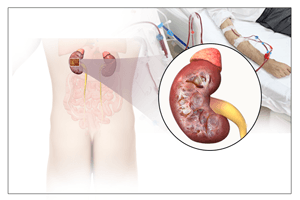
What Causes Kidney failure?
Some of the possible causes of kidney failure include:
- High blood pressure
- Diabetic nephropathy (kidney damage due to diabetes)
- Glomerulonephritis (inflammation of nephrons)
- Polycystic kidney disease (several cysts in the kidney)
- Reflux nephropathy (back-flow of urine into the kidneys)
- Certain medications
What are the Symptoms of Kidney failure?
Symptoms are generally not detected during the early stages of kidney disease until over 90% of the kidney has stopped functioning. Some of the symptoms include:
- Loss of appetite
- Sleeping difficulty
- Impaired concentration and headaches
- Changes in the appearance and amount, or presence of blood in the urine
- Pain in the region of the kidney
- Swollen legs and ankles
How is Kidney failure Diagnosed?
Various diagnostic tests are performed to determine kidney function. They include:
- Blood tests to determine the estimated glomerular filtration rate (eGFR), which measures the ability of kidneys to filter waste products
- Blood pressure measurements
- Urine tests to determine the presence of red blood and white blood cells, glucose and albumin
- Imaging tests such as X-rays, computed tomography (CT) scan, and ultrasound
- Kidney biopsy, where a small sample of tissue is removed for microscopic examination
How is kidney failure Treated?
Dialysis is recommended when most of the kidney’s filtrating ability is lost and dangerous amounts of wastes and fluid build-up in your body. There are two types of dialysis including:
- Hemodialysis: This uses an external dialysis machine to re-route blood for filtering. Patients with kidney failure may require 3 sessions of hemodialysis every week for four hours each. Your doctor will first measure your blood pressure, pulse and skin temperature before starting hemodialysis. Two needles are inserted into the arteriovenous (AV) fistula (surgically modified blood vessel) in your wrist or upper arm. The AV fistula is created a few weeks before hemodialysis. During dialysis, blood from your body is removed through one needle and is transferred to the dialysis machine. Membranes present in the machine act as filters to remove wastes and excessive fluid from the blood. The clean blood is then circulated back into your body through the second needle. After the session, the needles are removed and the area is covered to prevent bleeding.
-
Peritoneal dialysis: Unlike hemodialysis, peritoneal dialysis involves the use of the peritoneum or abdominal lining to filter blood. For peritoneal dialysis, your doctor first creates an access point by making an incision below your navel and inserts a catheter (a permanently attached thin tube). Your doctor pumps a special dialysis fluid into the surrounding space of the peritoneum (peritoneal cavity). Waste products and excessive fluids are transferred into the dialysis fluid from the blood. Your doctor will then drain out the dialysis fluid and seal the end of the catheter.
Are there any Complications of Dialysis?
As with any procedure, dialysis involves certain risks and complications. They include:
- Fatigue
- Low blood pressure, invasive bacterial infections, muscle cramps and itchy skin with hemodialysis
- Peritonitis (bacterial infection of the peritoneum), hernia and weight gain with peritoneal dialysis
If you wish to be advised on the most appropriate treatment, please give us a call at to schedule an appointment or request an appointment online.