
What is a Penile Implant?
A penile implant is a medical device that is surgically placed inside the penis to help men achieve an erection suitable for sexual intercourse. It is a highly effective treatment for erectile dysfunction (ED) when medications, injections, vacuum erection devices, or other therapies have not provided satisfactory results.
Penile implants do not increase sexual desire, sensation, or orgasm. Instead, they restore the ability to achieve and maintain an erection. Most implants are concealed entirely within the body, allowing for a natural appearance and discreet use.
There are two main types of penile implants: inflatable implants and malleable (semi-rigid) implants. Inflatable implants are the most commonly used because they provide a more natural-looking erection and flaccid state. Your urologist will recommend the most appropriate option based on your medical history, lifestyle, and personal preferences.
What are the Benefits of a Penile Implant?
A penile implant offers a reliable, long-term solution for men with erectile dysfunction that has not responded to other treatments. Benefits include:
- Provides a dependable, long-lasting treatment for erectile dysfunction.
- Allows erections sufficient for sexual intercourse.
- Offers high patient and partner satisfaction rates.
- Produces a natural-looking erection with inflatable devices.
- Concealed completely inside the body with no visible external components.
- Enables spontaneous intimacy without the need for medications before sexual activity.
- Does not affect sexual sensation, orgasm, or ejaculation if these functions were normal before surgery.
- Eliminates the need for ongoing injections or vacuum devices.
- Durable devices designed to provide many years of reliable function.
When is a Penile Implant Recommended?
Your urologist may recommend a penile implant when other treatments for erectile dysfunction have been unsuccessful or are not appropriate. Common indications include:
- Erectile dysfunction that does not respond to oral medications.
- Unsatisfactory results with penile injections or vacuum erection devices.
- Erectile dysfunction following prostate cancer surgery.
- Erectile dysfunction caused by diabetes or vascular disease.
- Peyronie's disease with erectile dysfunction.
- Neurological conditions affecting erectile function.
- Medication intolerance or contraindications.
- Desire for a permanent treatment option for erectile dysfunction.
What Does Preparation for a Penile Implant Involve?
Before surgery, your urologist will perform a comprehensive evaluation, including a review of your medical history, physical examination, and discussion of your treatment goals. Blood tests or other diagnostic studies may be ordered to ensure you are healthy enough for surgery.
Your doctor will explain the different types of penile implants and help you choose the most appropriate device. You should inform your healthcare provider about all medications, vitamins, and supplements you take, as certain medications, particularly blood thinners, may need to be temporarily discontinued.
You may also receive antibiotics before surgery to reduce the risk of infection and will be instructed to avoid eating or drinking for several hours before the procedure if general anesthesia is planned.
How is a Penile Implant Performed?
Penile implant surgery is performed under general or spinal anesthesia. After the anesthesia has taken effect, the surgeon makes a small incision near the base of the penis or in the lower abdomen, depending on the type of implant being used.
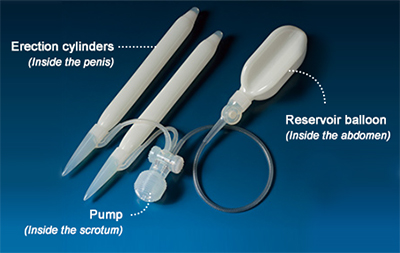
For an inflatable implant, two inflatable cylinders are placed inside the erectile chambers of the penis. A small fluid reservoir is positioned beneath the abdominal muscles, and a pump is placed inside the scrotum. These components are connected using thin tubing, all of which remain completely inside the body. When an erection is desired, squeezing the pump transfers fluid into the cylinders, creating a firm erection. After sexual activity, pressing the release valve returns the fluid to the reservoir, allowing the penis to become flaccid again.
For a malleable implant, flexible rods are inserted into the penis. The rods provide constant firmness and can be manually positioned upward for sexual activity or downward for everyday comfort.
Once the implant has been tested to ensure it functions properly, the incision is closed with sutures. The procedure typically takes one to two hours, and many patients return home the same day or after an overnight hospital stay.
What to Expect During Recovery After a Penile Implant?
Most patients experience mild to moderate discomfort, swelling, and bruising for several days following surgery. Pain is generally well controlled with prescribed medications, and antibiotics may be continued to help prevent infection.
Patients are encouraged to limit strenuous activity and heavy lifting for several weeks while healing occurs. Your surgeon will provide detailed instructions regarding wound care, bathing, and when normal daily activities may be resumed.
Inflatable implants are usually not activated until approximately four to six weeks after surgery, once healing is complete. During a follow-up visit, your urologist will teach you how to operate the device safely and comfortably. Most men can resume sexual activity after they have fully healed and receive clearance from their surgeon.
What are the Risks and Complications of a Penile Implant?
Penile implant surgery is generally safe and has a high success rate, but, as with any surgical procedure, there are potential risks. These include:
- Infection.
- Bleeding or hematoma.
- Pain or prolonged swelling.
- Device malfunction or mechanical failure over time.
- Implant erosion or movement (rare).
- Injury to surrounding tissues.
- Scar tissue formation.
- Need for revision or replacement surgery.
- Risks associated with anesthesia.
If you wish to be advised on the most appropriate treatment, please give us a call at to schedule an appointment or request an appointment online.