What is Robotic Prostatectomy?
Robotic prostatectomy is a minimally invasive surgery to treat prostate cancer and involves the removal of a part or whole of the prostate gland using a robotic surgical system.
Prostate cancer is one of the most common types of cancer in men that begins in the gland cells of the prostate. The prostate is a small walnut-sized gland located below the bladder in men and helps in the production of semen. Prostate cancer is a malignant cancer that can spread to the lymph nodes, bones, and other parts of the body and is the most common cause of death in elderly men over 70 years of age.
Robotic prostatectomy surgery is a new advanced laparoscopic approach that overcomes the limitations of the traditional open approach as well as the laparoscopic approach. It enables the surgeon to perform complex surgery through tiny incisions, with precision and ease, improving the outcome and reducing complications.
Mechanism of Robotic Prostatectomy
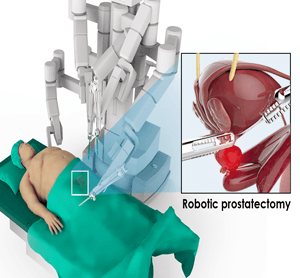
Robotic prostatectomy is similar to laparoscopic (keyhole) surgery, but robotic instruments are used instead of standard rigid keyhole instruments. The robotic arms are thin instruments designed to replicate the surgeon’s hands, and contains multiple joints which allow greater precision, increased range of motion and greater dexterity compared with standard laparoscopic instruments. The robotic instruments cannot do the surgery on their own. Instead, it translates the surgeon’s hand movements at the control unit, into precise movements of the miniature instruments at the operation site inside the body. Robotic surgery also gives the surgeon 3-dimensional vision which is greatly magnified to allow precise surgery.
Procedure for Robotic Prostatectomy
Robotic prostatectomy is usually performed under general anesthesia. You will lie down on the operating table in a supine (face-up) position. You will be given antibiotics to help prevent any infection. The robotic system includes two machines, a control unit or the surgeon’s console, and a patient unit. The surgeon sits at the control unit, away from the operating table, and controls the movement of the four robotic arms of the patient unit present near the operating table. Several small keyhole incisions are made in the lower abdomen. One of the robotic arms holds and positions a 3D high-definition camera through one of the incisions in the operated area and provides images of the operation site to the surgeon at the control unit. These images are high-resolution 3D images and are magnified 10 to 12 times. The other three robotic arms are used to hold small miniature surgical instruments that are introduced through other tiny incisions. The prostate is removed through one of the incisions. The enhanced vision and superior control of the micro-instruments help in the precise removal of the prostate without damaging the nerve fibers and the blood vessels near it, which are critical for the maintenance of bladder control and erectile function.
Postoperative Care and Recovery
In general, postoperative care instructions and recovery for robotic prostatectomy will involve the following steps:
- You will be transferred to the recovery area where your nurse will closely observe you for any allergic/anesthetic reactions and monitor your vital signs as you recover.
- You will wake up with a urinary catheter tube placed in the bladder through the urethra. There will also be a drain tube from the abdomen to allow drainage of gas and fluid from the operation site.
- You may experience pain, inflammation, and discomfort around the operated area. Pain and anti-inflammatory medications are provided as needed.
- You should be able to eat and drink normally and get up and walk the next day. The drain tube is also removed the day after surgery.
- You are encouraged to walk around post surgery to prevent the risk of blood clot formation and help with the healing process.
- You will likely be discharged on day 2 or day 3 after the operation depending on how comfortable you are. You will return home with the catheter in place. Most men need a urinary catheter for 10 days after surgery. The catheter is usually removed after a couple of weeks during your follow-up visit.
- You will need to resume your activity level gradually. You should be back to your normal routine in about four to six weeks with certain activity restrictions.
- It is important to keep the surgical site clean and dry. Instructions on surgical site care and bathing will be provided.
- Refrain from driving until you receive your doctor’s consent. Most patients can resume driving after a couple of weeks following surgery.
- A periodic follow-up appointment will be scheduled to monitor your progress.
Advantages of Robotic Prostatectomy
Some of the benefits of robotic prostatectomy over traditional open or laparoscopic surgery include:
- Minimal scarring
- Smaller incisions
- Less bleeding
- Precision in excision of cancerous tissue
- Minimal risk of damage to adjacent tissues
- Faster recovery
- Decreased risk of complications
- Clinically superior outcome
Risks and Complications
Robotic prostatectomy is a relatively safe procedure; however, as with any surgery, some risks and complications may occur, such as:
- Infection
- Bleeding
- Infertility
- Impotence
- Erectile dysfunction
- Adverse reactions to anesthesia
- Damage to surrounding tissue/organs
- Urethral stricture (block in the urethra)
- Bowel incontinence (problems controlling bowel movement)
- Urinary incontinence (difficulty controlling urination)
- Retrograde ejaculation (flow of sperm to the urinary bladder instead of through the penis)
If you wish to be advised on the most appropriate treatment, please give us a call at to schedule an appointment or request an appointment online.